April 20 , 2026
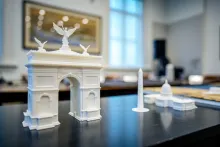
Opinion - The announcement of a triumphal arch in Washington, D.C., commemorating the recently declared U.S. victory over Iran has quickly become one of the most debated cultural proposals of the moment. The concept has now cleared an initial hurdle, with the U.S. Commission of Fine Arts—whose members were appointed by President Donald Trump—granting early approval on artistic grounds.
Lost in the immediate political reactions, however, is a broader and more enduring question: what role should national monuments play in marking consequential events, particularly those tied to conflict?
Supporters of the arch argue that the United States has a long, if selective, tradition of commemorating defining national moments through monumental architecture. Washington itself is a landscape shaped by symbolism—its memorials not only honoring individuals, but also expressing collective memory and aspiration. A triumphal arch, modeled on classical precedents and envisioned at a point to the capital, would fit squarely within that tradition.
The timing is also notable. The country approaches the 250th anniversary of its founding, and public officials across administrations have sought ways to mark that milestone with lasting civic works. The proposed arch, rising roughly 250 feet and designed as a prominent visual landmark, is intended to contribute to that commemorative landscape.
Criticism has focused on both process and symbolism—particularly the perception that a commission composed of presidential appointees may not reflect a broad spectrum of public opinion. Those concerns deserve to be acknowledged. Yet it is also true that the Commission of Fine Arts exists precisely to evaluate design and aesthetics, and its approval, even if preliminary, signals that the proposal meets a recognized standard of architectural seriousness.
More importantly, monuments are not static endorsements of a single political viewpoint. Over time, their meanings evolve. Structures initially conceived as celebrations often become places of reflection, reinterpretation, and even critique. The presence of a triumphal arch need not foreclose debate about the conflict it commemorates; rather, it can provide a focal point for that debate in the decades ahead.
There is also a case to be made for architectural ambition. Washington is a city defined by carefully planned vistas and symbolic forms, yet it has seen relatively few additions of major new monumental structures in recent generations. A thoughtfully executed arch could add visual dynamism to a familiar landscape, drawing visitors and encouraging renewed engagement with the capital’s civic spaces.
None of this diminishes the importance of careful execution. Questions of cost, siting, historical preservation, and public consultation remain essential and should be addressed transparently as the project advances. Early approval is only one step in what will likely be a lengthy process.
But the existence of controversy is not, in itself, an argument against building. On the contrary, it underscores the significance of the moment being marked. If the United States is to commemorate its victory over Iran—however complex or contested—there is value in doing so in a way that is visible, durable, and open to reinterpretation.
A triumphal arch, approached with restraint and historical awareness, offers precisely that possibility: not just a symbol of victory, but a structure through which future generations can grapple with what that victory meant.
Copyright © 2026. All rights reserved.